149053 stories
·
1 follower

A Russian Agent At The Right Hand Of Bin Laden? - Jamestown

1 Share

The Arabic television channel Al Jazeera broadcast an audiotape on December 19, 2003, that was said to be from Dr. Ayman al-Zawahiri, the right hand man of al Qaeda leader Osama bin Laden. In it, Zawahiri claimed that his group was chasing Americans everywhere, including in the United States. This claim helped raise the terror threat level.

But where is Zawahiri, whose head now carries a price of US$25 million? Recent media reports have said that he is hiding in Iran, though Iranian authorities deny this. Yet it could be that Russian intelligence knows exactly where he is and may even have regular contact with the elusive Egyptian.

Zawahiri as Prisoner

There are many accounts of Ayman al-Zawahiri published in the press. These stories cover Zawahiri’s childhood and his relatives, his study of medicine, his connections to the Muslim Brotherhood, his involvement in the assassination of Egyptian President Anwar Sadat, his close relations with Osama bin Laden, and his role in major terrorist attacks against the United States. But there are few authors who mention that Zawahiri spent half a year in close contact with representatives of Russian intelligence while in their custody.

Significantly, these contacts led to a change in Zawahiri’s political orientation. Long talks with Russian intelligence officers “forced a critical change in his lethal planning. …America, not Egypt, became the target… Freed from Russian jail in May 1997, Dr. Zawahri found refuge in Afghanistan, yoking his fortunes to Mr. bin Laden. [Zawahiri’s group] Egyptian Jihad, previously devoted to the narrow purpose of toppling secular rule in Egypt, became instead the biggest component of al Qaeda and a major agent of a global war against America. Dr. Zawahri became Mr. bin Laden’s closest confidant and talent scout.” [1]

The story of Zawahiri’s Russian experience begins on December 1, 1996, when he was traveling under the alias “Mr. Amin” along with two of his officers–Ahmad Salama Mabruk, who ran Egyptian Jihad’s cell in Azerbaijan under the cover of a trading firm called Bavari-C, and Mahmud Hisham al-Hennawi, a militant widely traveled in Asia. The group was accompanied by a Chechen guide. They were trying to enter Russia between the Caspian Sea and the Caucasus Mountains in an effort to discover whether Chechnya could become a base for training militants. It was here that the group was arrested by Russian police for a lack of visas. They were soon handed over to the Federal Security Service, the successor to the KGB.

When Zawahiri’s computer was later discovered in Afghanistan by two journalists, it provided insight into Zawahiri’s side of the story. In short, it goes as follows:

The Russians failed to: 1) find out Zawahiri’s real identity and the goals of his visit to Chechnya; 2) read the Arabic texts in his laptop, which would have revealed the nature of his activities; and 3) read the coded messages that he sent from custody to his friends.

Zawahiri’s Version Debunked

Yet based on my own twenty years’ experience with Russian intelligence people involved in Arab affairs, these claims simply do not ring true. The Soviet KGB had good–albeit indirect–connections with Islamic fundamentalists, including the Muslim Brotherhood and the Egyptian Jihad. The curriculum of Arab terrorists who studied at Moscow International’s Lenin School placed special emphasis on cooperation between Marxists and Islamists. Soviet instructors would encourage Arab terrorists to consider the Muslim Brothers and other Islamic extremists as “allies in class struggle.”

Good contacts between the KGB and Islamic fundamentalists existed at the time of the Egyptian Jihad’s 1981 assassination of Anwar Sadat, after which Zawahiri was jailed by Egyptian authorities. Since the KGB followed these events very closely and may have even been indirectly involved in the plot, the KGB would have put Zawahiri’s name into its records at that time. Therefore, when Zawahiri crossed the KGB’s path again, that organization likely would have soon discovered his real identity.

Additionally, local Islamic organizations flocked to Zawahiri’s aid during his detention and trial in such large numbers that the Russians and even Zawahiri’s own lawyer were puzzled by the outpouring. [2] This would have been another tip-off to the authorities that they had more than just a mere merchant (Zawahiri’s reported claim) in custody. Also, the fact that he was arrested along with a Chechen should have raised additional suspicions.

Perhaps most difficult to believe from Zawahiri’s version is that his captors would not have read the Arabic information contained within his laptop computer. Russian intelligence has probably the best Arabists in the world. One of them–Dr. Evgeny Primakov–headed the Russian Foreign Intelligence Service from December 1991 until January 1996 and made a considerable efforts to bring many talented Arabists into this service. These individuals would have been able not only to read Zawahiri’s Arabic text, but also to decode his encrypted messages without any problem.

Thus, with Zawahiri’s true identity and purpose uncovered by the Russians, these authorities would have been faced with several options. One would have been deportation to either Egypt or the United States, with gratitude from those governments for Russian President Yeltsin, burnishing his image as a fighter against terrorism. But apparently the Russians decided not to do this, believing perhaps that their national interest was better served by another alternative.

One should bear in mind that at the time of Zawahiri’s capture, Chechnya was enjoying a period of actual independence from Moscow. The Kremlin was having great difficulty finding “agents of influence” among the Chechen people. At the same time, Moscow knew that representatives of al Qaeda and other foreign Islamic fundamentalists were present in Chechnya and exercised strong influence on the Chechen leaders, especially on the military commanders. It would have been logical, therefore, for the Russians to try to persuade Zawahiri to cooperate with them in directing the activities of Arabs in Chechnya, in getting information about the plans and activities of Chechen leaders, and in influencing the Chechen leadership.

It may not have been too difficult for Russian officers to persuade Zawahiri to go along with such a plan. The prisoner would have been very frightened by the prospect of being deported to Egypt or remaining jailed in Russia. Furthermore, methods of torture during interrogation used by KGB officers would have truly almost scared Zawahiri to death. Execution very likely was just one threat.

Once made aware that the KGB knew of his true identity, Zawahiri would have realized that it would be useless to lie further. At a minimum, Zawahiri would have had to agree to cooperation with Russian intelligence to save his life and to buy his freedom. It is possible that the Russians also offered some form of assistance to Zawahiri and al Qaeda. This could have been in the form of explosive technology or other weaponry.

It is notable that Taliban and al Qaeda militants in Afghanistan received regular re-supplies of Russian arms. The man responsible for these deliveries was Victor Anatolievich Bout, the son of a top KGB officer. His father’s connections helped establish Bout in the arms trade, which is linked to the Russian government and particularly to its intelligence services. Bout and his family currently reside in the United Arab Emirates. [3]

It is also not difficult to imagine that the Russians managed to get some information from Zawahiri about his colleagues that could have been used to blackmail him if he tried to avoid cooperation after his release. With an agreement reached between Zawahiri and the Russians, the authorities would have taken steps to make the Egyptian look “clean” to his Arab comrades and the Chechens. It would not have been difficult for them to stage Zawahiri’s trial, at which the judge gave him only a six months’ sentence, much of which he had already served.

A final note: Arabs are still very active among the Chechen militants today, and yet the Russians appear to turn a blind eye toward their infiltration and do not hunt them particularly. Even the most influential among the Arabs, Khattab, may well have been killed by his own people. Arabs have also never been listed as POWs. Perhaps the Russian forces have an order to kill Arabs on the spot: Nobody wants them to reveal unwanted information during interrogations. Thus left alone, the Arabs exercise significant influence over the activities of Chechen commanders according to orders from Zawahiri. Presumably they do so without understanding that they could well be the Trojan horses who actually execute the Kremlin’s orders. For example, the Arabs apparently do not encourage Chechen militants to direct any attacks against Russian leaders in Moscow. This could be accomplished simply by refusing to pay for such operations.

In contrast, the Arabs do seem to encourage the taking of hostages from among the common people, as in the Moscow youth club Nord-Ost incident, thus making it easier for the Kremlin to stoke public anger against “Chechen terrorists.” This in turn helps Vladimir Putin garner popular support for his own authoritarian actions as well as those of his former KGB colleagues who now occupy 65 percent of top governmental positions. Dr. Zawahiri may thus be the queen in the Kremlin’s chess game not only in Chechnya, but also in Russia’s power struggle at the highest levels. If so, it is not likely that the Russians would surrender him merely to help win the global war on terror.

Dr. Novikov is a senior fellow at the Jamestown Foundation.

Notes:

1. “Saga of Dr. Zawahri Sheds Light On the Roots of al Qaeda Terror;” Andrew Higgins and Alan Cullison; The Wall Street Journal, July 2, 2002.

2. Ibid.

3. “International Business of Russian Mafia,” Sueddeutsche Zeitung, February 1, 2001.

Read the whole story
Michael_Novakhov
5 hours ago
reply
http://michael_novakhov.newsblur.com/
Share this story
Delete

Scary links: Russia, al-Zawahiri and Ukraine’s destruction

1 Share

For those who dismiss aid to Ukraine as pivotal to our security, at home and abroad, perhaps 9/11 will resonate. Here’s the backstory to the backstory of our July 31 drone strike that killed Ayman al-Zawahiri, head of al Qaeda, and the apparent connection.

In the 1970s, Ion Pacepa, head of Romanian foreign intelligence, visited General Alexander Sakharovsky, head of the KGB’s First Chief Directorate (foreign operations). “Terrorism has to become our main weapon,” he reportedly told Pacepa. Pointing to a world map bristling with red pins, each representing a hijacked airplane, Sakharosvky continued: “Airplane hijacking is my own invention.”

In 1987, GRU (the military counterpart of the KGB) defector Vladimir Rezun (aka, Viktor Suvorov), laid out a scenario: two successive plane crashes into the White House, the second one timed to obliterate the first responders and command structure who arrived the scene after the first crash.

In 1997, having spent six months in Russia, al-Zawahiri decamped to Afghanistan, becoming Osama bin Laden’s lieutenant and mastermind of 9/11. There promptly followed the 1998 U.S. embassy bombings in Africa, the 2000 bombing of the USS Cole, the 2005 London bombings, and more.  

Alexander Litvinenko was the defecting FSB officer in London who Vladimir Putin incinerated from the inside out with Polonium 210, nuclear terrorism in the Magna Carta’s backyard. A year before his 2006 assassination, and then again on his hospital deathbed, Litvinenko revealed that while in Russia-controlled Dagestan in the Caucasus, al-Zawahiri had undergone training by the FSB, Russia’s Federal Security Service and successor to the KGB. Dagestan was also the springboard for the subsequent two Boston Marathon bombers. 

The Russia connection was raised earlier by others, and Litvinenko’s disclosures are consistent with other information. Konstantin Preobrazhensky, a former lieutenant colonel in the KGB, confirmed and also wrote about the connection, via an Iraqi intelligence agent, between Mohammed Atta, the pilot of the first plane to crash into the World Trade Center, and Russian intelligence.

We also know that former KGB head Yurij Andropov, Putin’s pedagogue, reportedly saw the Islamic world “as a petri dish in which Moscow could nurture a virulent strain of America-hatred.” Moscow encouraged Arab nationalism in the 1970s and 1980s as the genome for Islamic terrorism, and helped train, finance, arm and direct the terrorist assault against us and our allies. Generic terrorism evidently was fine, too. Remember Paris, Athens, Vienna, London, West Berlin? The bomb attack in Brussels on Gen. Alexander Haig, commander of NATO? The murders of U.S. Ambassador Cleo Noel and his deputy, George Moore, in Sudan? The assassination of U.S. Ambassador J. “Chris” Stevens in Libya?

Yasser Arafat reportedly received a KGB makeover, and yet won the Nobel Peace Prize. Home-grown, non-Arab terrorists and agents were even better. Among those with alleged KGB involvement: Venezuelan Ilich Ramirez Sanchez, known as Carlos the Jackal, Germans Ulrike Meinhoff and Hans-Joachim Klein, Frenchman Regis Debray, adviser to President Mitterrand, Italian Prime Minister Romano Prodi, and Irish Republican Army luminary Sean Garland.

Western intelligence evidently knew perfectly well about Moscow’s role but was muzzled by the politicians for fear of “provoking” Moscow. Sounds familiar. Three British prime ministers bravely remained mum after Litvinenko’s murder. 

The German Stasi reportedly was a key player in Moscow’s terror network. There are plenty of reasons to conclude that in Dresden, Putin had a connection to the terror networks established by his mentors. Promptly after President Bush declared Iraq, Iran and North Korea the “axis of evil,” Putin reinstituted weapons sales and nuclear assistance to Iran. Iraq received a $40 billion trade deal. And North Korea’s despot, Kim Jung Il, was celebrated in Moscow. In 2003, Putin declared at a meeting of the Organisation of the Islamic Conference (OIC) that Russia was Islam’s historical defender, and Russia received associate status. The USSR was the first state to recognize Saudi Arabia in 1926 and initiated the World Muslim Congress in Mecca, the prototype of the OIC. And Russian operatives, in an apparent false flag operation, posed as ISIS and threatened to kill U.S. military families.

No surprise here. The rejection, subversion and destruction of Western values and its social fabric overlaps Russian fundamentalism with radical Islamic fundamentalism. Both market a vitriolic anti-Western, anti-American ideology, a faux morality playing the “America is immoral” card. Both are propelled to kill, to savage, to destroy. For both, it’s more than a duty; it’s an entitlement. 

Demonstrative affirmation of anniversary dates is a KGB passion. Putin critic Anna Politkovskaya was murdered on his birthday. And 9/11 saw Putin’s celebration of the birthday of the notorious Felix Dzerzhinsky, founder of the Cheka, precursor to the KGB/FSB. Dzerzhisnky had enthused: “We stand for organized terror — this should be frankly admitted. Terror is an absolute necessity.” The smoke hadn’t cleared before Putin was on the line to the American president with his professed condolences. Ditto after the Boston Marathon bombing.

Where are we today? 1997 also saw the appearance of Russia’s blueprint calling for, among other measures, an Islamic/Russian alliance against America. It specifically highlighted a  Russian/Iranian joint venture. The destruction of Ukraine was pivotal.

Fifty-one NATO and allied nations, including Ukraine, aided the U.S. in Afghanistan. After Russia’s invasion of Ukraine on Feb. 24, 2022, 141 nations signed the UN resolution condemning Russia. But for more than eight years, since the 2014 Russian invasion, Ukraine was alone in battling against the terrorist state that launched Islamic terrorism against the West. To add to the irony, for a generation Ukraine has contributed “boots on the ground” to our war on terror and peacekeeping missions. During our shambolic exit at Kabul airport last August, it was the Ukrainians who, in a special ops, rescued refugees the U.S. or NATO would not or could not rescue. 

Our post-9/11 war on terror cost $8 trillion and 22,000 casualties. Our aid to Ukraine, so far, is less than 1 percent of that, with no American casualties. Ukraine’s losses are staggering. One estimate placed Ukraine’s losses, in 2 ½ months, equal to America’s losses in Iraq and Afghanistan in over 20 years.

Now, following renewed shelling of Ukraine’s Zaporizhzhia nuclear power plant, Europe’s largest, Ukraine’s Energoatom nuclear agency reports the threat by Major General Valery Vasiliev. He’s in charge of Russia’s radiation, chemical and biological troops and has occupied the plant. “There will be either Russian land or a scorched desert. … As you know, we mined all the important objects of the Zaporizhzhia nuclear plant. And we do not hide this from the enemy. We warned them. The enemy knows that the plant will be either Russian or nobody’s. We are ready for the consequences of this step. And you, liberating soldiers, must understand that we have no other. And if there is the toughest order — we must fulfill it with honor!”

The global catastrophe would make Chornobyl a petty event. Let that sink in.  

We remain bulletproof against reality. Russia is not simply a state sponsor of terrorism. It was and remains the quintessential terrorist state. After eight years, we’re still rolling out sanctions? We must match Ukraine’s will and share its purpose. Strategic aphasia won’t cut it. 

Victor Rud has practiced international law in New York and New Jersey for 35 years. He is the past chairman of the Ukrainian American Bar Association and now chairs its Committee on Foreign Affairs. He is a senior adviser to Open Ukraine, a nongovernmental organization in Ukraine, and the senior adviser to the Centre for Eastern European Democracy in Toronto.

Copyright 2026 Nexstar Media Inc. All rights reserved. This material may not be published, broadcast, rewritten, or redistributed.

Read the whole story
Michael_Novakhov
8 hours ago
reply
http://michael_novakhov.newsblur.com/
Share this story
Delete

Ukraine Attacks Kerch Bridge Linking Russia to Occupied Crimea

1 Share

Destroying the structure, the only one connecting Russia to the occupied Crimean Peninsula, has long been a top objective for Kyiv.

The Kerch Strait Bridge in 2023. The structure is the only bridge linking Russia to Crimea, which Russian forces illegally annexed in 2014.Credit...Associated Press

Marc Santora and James McManagan

Marc Santora, who has covered the war in Ukraine since 2022, has written about each Ukrainian attempt to bring down the Kerch Strait Bridge.

A large section of the only bridge linking Russia to the occupied Crimean Peninsula collapsed into the sea on Tuesday after a series of Ukrainian strikes, according to photographs and video released by the Ukrainian government, and statements from officials in Kyiv.

Russian officials, who temporarily halted traffic on the structure, the Kerch Strait Bridge, acknowledged the damage and vowed to repair it.

The Ukrainian strikes were the culmination of years of attacks aimed at bringing down the bridge, a hulking symbol of Moscow’s control of Crimea, which Russia illegally annexed in 2014. The bridge is also a lifeline supplying Russian troops.

President Volodymyr Zelensky of Ukraine said in a statement that the attack came after months of planning. After degrading or destroying nearby air defenses, Mr. Zelensky said, Ukraine struck with missiles and drones.

While destroying the bridge has long been a top Ukrainian objective, Mr. Zelensky framed the strikes as a response to recent Russian attacks on Ukraine’s bridges and other infrastructure.

Hours before his statement, seven Russian ballistic missiles slammed into bridges over the Dnipro River in Kyiv, Ukraine’s capital. The bridges were temporarily closed, Ukrainian officials said.

Want to stay updated on what’s happening in Russia and Ukraine? , and we’ll send our latest coverage to your inbox.

Mr. Zelensky said, “We have repeatedly offered Russia steps toward de-escalation — and every proposal has been met with loud rejection.”

“We will never leave terror against our cities and people unanswered,” he added.

Image

Workers cutting electrical wires on the Southern Bridge in Kyiv, which was damaged in an overnight strike.Credit...Evgeniy Maloletka/Associated Press

The Kremlin spokesman, Dmitri S. Peskov, noted that President Vladimir V. Putin had been briefed on the attack. “There is no doubt that the bridge will be restored and will be even better than the previous one,” he said in a statement.

The strikes on bridges hundreds of miles from the front lines were part of a long-running battle involving logistics, symbols and survival. Heavily fortified bridges are some of the hardest structures to bring down using long-range weapons.

The 12-mile Kerch Strait Bridge was opened in 2018, four years after Russia seized Crimea, and cost $3.7 billion. It has come under repeated attack by Ukraine since Moscow’s full-scale invasion in 2022, both through sabotage operations and bombardments.

With each attack, Moscow has stepped up defenses, making the bridge one of the world’s most heavily protected pieces of infrastructure.

The defensive shield includes batteries of long- and short-range air-defense systems, backed by electronic jamming equipment and smoke generators to blind incoming missiles. In the water, Russian forces have anchored rows of sunken and floating barges linked by boom barriers and nets to block drones. The authorities also installed vehicle-screening checkpoints at both entrances.

The operation to breach those defenses played out over several weeks, according to Ukraine’s domestic intelligence service, the S.B.U. Ukrainian forces hunted down radar stations and air-defense batteries across Crimea, tearing a hole in the umbrella shielding the strait, according to Ukrainian officials.

Ukraine attacked the bridge on Monday. A wave of drones struck a central arch, bending the steel ribs and leaving the support tilting under the weight of the road suspended below, officials said.

Before Russian engineers could stabilize the structure, Ukraine launched a second barrage of drones alongside its domestically built Flamingo cruise missiles, which carry warheads large enough to sever steel girders.

When those missiles slammed into the weakened span, the arch buckled completely, sending the roadway plunging into the water.

Artem Dekhtiarenko, an S.B.U. spokesman, said in a statement, “For years, the Russians have convinced the whole world that the Crimean Bridge is one of the most protected objects on the planet.”

“Today, parts of it lie on the seabed,” he added.

Footage from a Ukrainian drone shows a warhead flying toward the bridge before seemingly losing its connection. The video was first posted by a former adviser to the Ukrainian government and was later reposted by the drone’s manufacturer.

A second drone video released by the S.B.U. showed the aftermath of the attacks, with the arches and deck of the eastern side of the bridge destroyed. Social media video circulating Tuesday, verified by The New York Times, also shows a section of the eastern side destroyed, as seen from the shores of Crimea.

The Kerch bridge consists of two parallel spans — one for road traffic and another for rail — resting on long steel girders supported by reinforced concrete pillars driven into the seabed.

Near the center of the strait, both decks rise into a pair of huge steel arches that lift the roadway some 115 feet above the water so large cargo ships can pass below.

Because the span is divided into hundreds of sections, destroying one stretch does not cause a chain reaction across the rest of the bridge, making the structure difficult to knock down completely.

Image

The Kerch Strait Bridge after being hit in 2022.Credit...Associated Press

Ukraine has struck the bridge at least three times in the past.

In 2022, a truck laden with explosives detonated on the bridge, collapsing roadway spans and igniting a passing fuel train. Ukrainian forces followed up with a strike in July 2023 using naval drones that damaged the road deck. In June 2025, Ukraine conducted an underwater demolition operation involving more than a metric ton of explosives against the bridge’s submerged support pillars.

Nataliia Novosolova and Ivan Nechepurenko contributed reporting.

Marc Santora has been reporting from Ukraine since the beginning of the war with Russia. He was previously based in London as an international news editor focused on breaking news events and earlier the bureau chief for East and Central Europe, based in Warsaw. He has also reported extensively from Iraq and Africa.

Related Content

Advertisement

SKIP ADVERTISEMENT

Add the Sunday Times in print to your subscription. 50% off the first year. Learn more.

Read the whole story
Michael_Novakhov
1 day ago
reply
http://michael_novakhov.newsblur.com/
Share this story
Delete

Putin is not ready to make peace in Abu Dhabi

1 Share

As the Russian-Ukrainian war, which long ago entered a phase of attrition, grinds on, Russia, Ukraine and the United States began a new round of US-brokered trilateral talks in Abu Dhabi, the capital of the United Arab Emirates, on November 10. The talks are scheduled to continue on November 11.

The talks follow a successful humanitarian operation in Oleshky, a southern Ukrainian town that has been occupied by Russian forces since 2022.

Starting in December 2025, Oleshky experienced a food crisis that worsened dramatically in the summer of this year. Over the years under Russian occupation, its population declined from 25,000 to 2,000 people, and the food crisis threatened the survival of those who remained. In the summer, however, Ukrainian and Russian intelligence services agreed to work on a local ceasefire in order to evacuate Oleshky’s inhabitants – if they wanted to leave – either to Ukraine or to Russia.

The humanitarian mission went surprisingly smoothly. Both sides stood by the ceasefire agreement, hundreds of people were successfully evacuated (mostly to Ukraine) from the long-suffering town, and it was extraordinary to see the Ukrainian and Russian human rights representatives, Dmytro Lubinets and Yana Lantratova, coordinating the humanitarian mission peacefully and with mutual respect.

Can this successful mission lay the groundwork for – or at least contribute to – progress in the Abu Dhabi peace negotiations brokered by the US between Russia and Ukraine? Several factors suggest that this is unlikely.

One immediate indicator is that the success of the mission in Oleshky was driven not by Moscow’s desire for peace but by its willingness to pander to Donald Trump’s vanity against the background of his animosity towards Ukraine’s President Volodymyr Zelenskyy.

It has long been known that Trump wanted to be awarded the Nobel Peace Prize. However, despite his claims that he has ended countless wars around the world, Trump is unlikely to receive this prestigious award. Today, it seems that the Trump family’s plan is to try to secure the Nobel Peace Prize for Melania Trump.

The Oleshky humanitarian mission seems to be a case in point. A few days before the ceasefire, the White House announced that it was Melania Trump – in “her formal role as Exclusive Intermediary” – who had initiated discussions on the ceasefire agreement between Russia and Ukraine, thus dismissing not only the Vatican’s efforts to secure the Oleshky ceasefire, but also the fact that Ukrainian and Russian intelligence services had already begun discussing the temporary armistice in the summer. Moscow, however, readily backed Washington’s version of Melania Trump’s critical role in the agreement, and Kyiv had to align with that version, too.

Both Russia and Ukraine are seeking to win Donald Trump over to their side, but while both countries eventually agreed to play along with the White House’s promotion of the US first lady as a “peacemaker”, Moscow presumably considered that the success of the Oleshky humanitarian mission would benefit it more than Kyiv. Putin’s apparent reasoning here is that Moscow’s apparent willingness to cooperate may deepen Trump’s disaffection with Zelenskyy and strengthen his delusion that it is Ukraine rather than Russia that is blocking the path to the end of the war. For Putin, winning Trump over would be a way to continue the aggression against Ukraine under more favourable circumstances – not a way to come to peace with Ukraine.

Another factor suggesting that the Abu Dhabi talks are unlikely to result in progress towards lasting peace is that Moscow appointed Vladimir Medinsky, Putin’s aide, as the head of the Russian delegation for the talks in the UAE. Medinsky headed the Russian delegations for the negotiations with Ukraine in Istanbul in 2022 and 2025, and his reappointment as the delegation’s leader for Abu Dhabi suggests that the Russian position on Ukraine has not changed since the Istanbul negotiations. The only acceptable outcome of the war for Russia remains Ukraine’s surrender, and surrender was unacceptable to Ukraine in 2022 and 2025, and remains so today.

However, Putin appears to believe that Russia is in a stronger negotiating position than Ukraine, and his belief is grounded in both erroneous and realistic assumptions.

On the one hand, it is a mistake on Putin’s part to assume that the constant Russian attacks on Ukrainian infrastructure, including energy and water supplies, can undermine Ukrainians’ resilience to the point where they will demand that the authorities surrender to Russia or rebel against the government. Ukraine is fighting an existential war, in which surrender means death, torture and ethnic cleansing – practices characteristic of Russian rule in the currently occupied Ukrainian territories. Ukrainians simply have no choice other than to resist the Russian aggression.

On the other hand, Moscow is correctly assessing developments across the West, where continuing support for Ukraine is being challenged on several fronts. While European nations keep financing weapons supplies for Ukraine’s defence, a large share of the weapons the country needs comes from the US. The joint US-Israeli war against Iran depleted some US stockpiles, and US capacity to restock them is limited, which creates a significant gap in Ukraine’s offensive and defensive efforts, especially when it comes to air defence. The Democratic Party’s victory in the US midterm elections will hardly change the situation, even though the party has been more favourable to Ukraine than the Republicans: the shortage of weapons that the US can sell to Ukraine via its allies is a material rather than a political issue.

Moreover, the continued military and economic support that Ukraine receives from its European and other allies depends not only on the political consensus among those allies about the need for such support, but also on the individual positions of those allies. France will hold a presidential election in the first half of 2027, potentially followed by snap parliamentary elections, and the right-wing nationalist party National Rally has a good chance of securing both the presidency and the premiership of the French Republic. Its informal leader, Marine Le Pen, who has announced that she will stand for the presidency in the spring of next year, has already said that France can no longer provide financial assistance to Ukraine, implying that she would stop that financial aid if elected president. Despite the fact that France is the second-largest economy in the EU, it is only the fifth-largest bilateral EU donor to Ukraine; but France is an influential European country, and if it stops financial support for Ukraine, this may produce a domino effect among some other EU countries and create more economic and internal political pressure on those EU governments that continue to aid Ukraine.

Marine Le Pen, whose party received financial support from Russia in 2014 and who met Putin personally in Moscow in 2017, is most likely Russia’s best bet for 2027 with regard to weakening Ukraine’s defence. But this is not the only bet. In Germany, the right-wing nationalist party Alternative for Germany is surging in the polls, and it is the largest openly pro-Putin and pro-Trump party in the EU. And Trump himself, despite his Republican Party’s losses in the 2026 US midterm elections, remains one of Russia’s important bets in the context of the Russian war.

The fact that Russia participated in the trilateral negotiations in Abu Dhabi is not a sign that it is ready for peace with Ukraine. It is not – Russia hopes that Western support for Ukraine will wither away, and believes it has the resources to wait for that hypothetical moment.

The views expressed in this article are the author’s own and do not necessarily reflect Al Jazeera’s editorial stance.

Read the whole story
Michael_Novakhov
1 day ago
reply
http://michael_novakhov.newsblur.com/
Share this story
Delete

Sanctioned Russian jet carrying military intel. chief lands in Israel after departing Moscow base

1 Share
Updated:

A Russian military transport aircraft carrying a senior delegation led by the head of Russia’s military intelligence agency landed at Ben-Gurion Airport on Sunday evening in an unusual visit, two sources familiar with the matter told The Jerusalem Post.

The delegation, which met senior Israeli defense officials, was headed by Admiral Igor Kostyukov, chief of the Main Directorate of the General Staff of the Armed Forces of the Russian Federation, commonly known as the GRU, Russia’s military intelligence agency.

The purpose of the visit and the subjects discussed during the delegation’s meetings in Israel remain unclear, but the unusual landing of a Russian military aircraft in Israel comes amid heightened regional tensions and ongoing uncertainty over the possibility of renewed military confrontation between the US, Israel and Iran.

The Russian aircraft departed Israel and headed to Abu Dhabi.

The Russian delegation, including Kostyukov, will participate in the Russian-Ukrainian negotiations under US mediation scheduled for Tuesday-Wednesday.

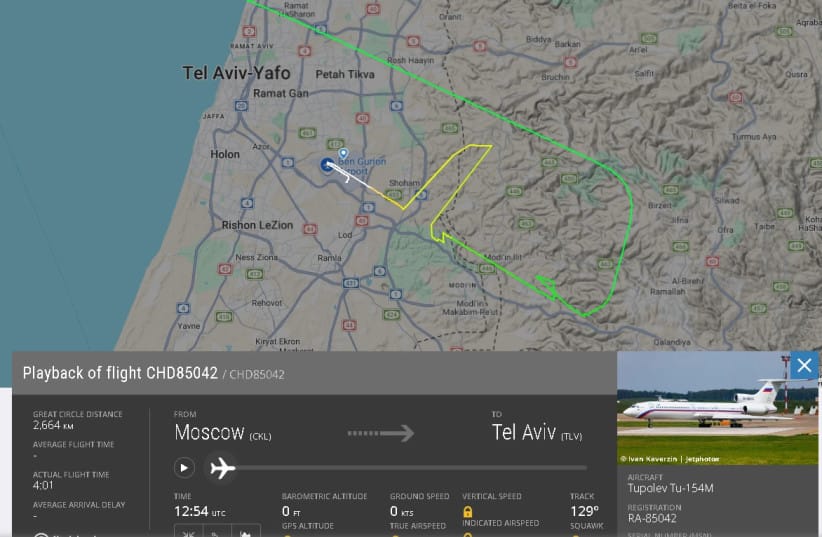
Flightracker screenshot of flight CHD85042, November 9, 2026.Flightracker screenshot of flight CHD85042, November 9, 2026. (credit: FLIGHTRADAR24/SCREENSHOT)

The Tupolev Tu-154M is operated by the Russian Defense Ministry and departed from a military base near Moscow, flight-tracking data from FlightRadar24 showed.

The jet has been on the US sanctions list since 2023.

The Chkalovsky Air Base, from which the flight originated, is the primary operational hub for the Russian Defense Ministry, which manages VIP transport and government missions for high-ranking military officials and official delegations.

The flight path went over the Black Sea and through Turkish airspace before entering Israel from the Mediterranean. The plane circled over Israel before landing at Ben-Gurion Airport at about 7 p.m.

Flightradar24 data showed that in the past week, the aircraft has remained in Moscow since arriving from Novosibirsk on November 2.

Aircraft sanctioned by US for assisting Wagner mercenary group

The aircraft belongs to the 223rd Flight Unit of the Russian Defense Ministry, itself a sanctioned entity, as the US State Department accused the unit of transporting personnel and equipment belonging to the Wagner mercenary group to countries where Wagner operated.

The aircraft was listed under Executive Order 14024, which authorizes sanctions targeting Russia's harmful foreign activities, including those connected to its war against Ukraine.

As part of the May 19, 2023, action, the US identified 37 aircraft associated with the unit as blocked property, including RA-85042.

When approached by The Jerusalem Post, the Russian Embassy in Israel declined to comment on who was in the aircraft or why they were in Israel.

Additionally, the IDF declined the Post's request for comment.

The Post also reached out to several US government bodies for comment.

Follow us on Google
Read the whole story
Michael_Novakhov
1 day ago
reply
http://michael_novakhov.newsblur.com/
Share this story
Delete

Instances when the counterintelligence investigations were wrong

1 Share

Instances when the counterintelligence investigations were wrong

AI Mode reply for Instances when the counterintelligence investigations were wrong

Counterintelligence investigations typically go wrong in two ways: .

Notable False Positives (Wrongly Accused Targets)

  • The CIA "Mole Hunt" (1960s–1970s). Led by counterintelligence chief , the CIA launched an aggressive internal search for a high-level Soviet spy based on the claims of defector . The investigation paralyzed the agency's Soviet division, ruined the careers of dozens of loyal intelligence officers, and wrongly imprisoned defector for years in harsh conditions.
  • Wen Ho Lee (1999). A Taiwanese-American scientist at Los Alamos National Laboratory was accused by the FBI and Department of Energy of stealing nuclear weapons secrets for China. He was held in solitary confinement for nine months before the government's espionage case collapsed, resulting in him pleading guilty to a single minor charge of mishandling data and receiving a formal apology from the presiding judge.
  • Brandon Mayfield (2004). Following the Madrid train bombings, FBI fingerprint examiners erroneously matched a partial print found at the scene to Mayfield, an Oregon attorney and Muslim convert. Despite warnings from Spanish authorities that the print did not match, the FBI detained him for two weeks before Spanish investigators linked the print to an Algerian national, forcing the U.S. government to apologize and pay a $2 million settlement.
  • The Dreyfus Affair (1894). French military counterintelligence wrongly convicted Captain , a Jewish artillery officer, of passing military secrets to the German Embassy. Investigators ignored evidence pointing to the real culprit, Major , and fabricated documents to uphold the conviction before Dreyfus was eventually exonerated years later.
  • Richard Jewell (1996). While primarily a domestic terrorism case, the FBI's profiling-driven focus on security guard Richard Jewell after the in Atlanta became a textbook example of confirmation bias. Agents leaked his name as the prime suspect before clearing him months later and catching the actual bomber, .

Notable False Negatives (Missed Spies & Blind Spots)

  • The Cambridge Five (1930s–1950s). British counterintelligence repeatedly overlooked evidence that a ring of upper-class recruits—including Kim Philby, Donald Maclean, and Guy Burgess—were spying for the Soviet Union. Class bias and institutional loyalty led MI5 and MI6 to dismiss suspicions, allowing Philby to reach the top ranks of British intelligence and even serve as a liaison to the CIA.
  • Aldrich Ames and Robert Hanssen (1980s–2001). Both the CIA and FBI suffered catastrophic counterintelligence failures by failing to detect high-level moles within their own ranks for years. In both cases, investigators initially blamed compromised Soviet assets on technical breaches or poor tradecraft rather than an insider, allowing Ames and Hanssen to operate undetected despite glaring red flags like unexplained wealth.
  • The China Initiative (2018–2022). Launched by the U.S. Department of Justice to combat Chinese economic espionage, several high-profile investigations against academic researchers—such as MIT professor Gang Chen and University of Tennessee professor Anming Hu—collapsed in court or were dropped after prosecutors failed to prove intent to defraud or espionage ties.

Are you interested in exploring a specific case in more detail, or looking at how agencies reformed their vetting and investigative standards after these failures?

Copied to clipboardFailed to copy to clipboard. Try again later.

  • Counterintelligence failures - Wikipedia

    UK Failures: Cambridge Five (Kim Philby, Donald Maclean, Guy Burgess, Anthony Blunt), internal suspicion damaging morale. Defensiv...

  • The Most Tragic Intelligence Failures in World History...

    Oct 18, 2023 — the Cambridge spy ring, where British government secrets were leaked to the Soviet Union for 20 years.

  • List of CIA controversies

    Security failures Counterintelligence failures Perhaps the most disruptive incident involving counterintelligence … search for a m...

  • The 10 Biggest Blunders in The History Of Espionage

    February 9, 2015 — Dreyfus Affair falsified military intelligence, sparking a national crisis. atomic secrets through Britain.

  • Top 10 Most Damaging Spy Missions in History

    March 3, 2023 — Aldrich Ames (CIA/FBI double agent for Soviets, compromised HUMINT); Robert Hanssen (FBI/Soviet double agent); (executed for atomi...

  • YouTube·FORGOTTEN HISTORY

    American Intelligence's Biggest Failure - Robert Hanssen

    Aug 19, 2025 — Aldrich Ames, a CIA mole unknown to Hanssen, provided information about Dmitri Polyakov, a Soviet GRU major general who spied for ...

  • The One Mistake That Caught Every Spy

    November 1, 2026 — The One Mistake That Caught Every Spy. The Rosenbergs: betrayed by a brother * 3:12 Richard Sorge: Anna Chapman: the fake passport...

Read the whole story
Michael_Novakhov
4 days ago
reply
http://michael_novakhov.newsblur.com/
Share this story
Delete
Next Page of Stories